I am Felicity Deverell, a young Northland artist with a passion for traditional
art and for adventure in the beautiful outdoors. Two years ago, with the help of
my friend, Caleb Bergstrom, I had an idea for creating a collection of artworks
portraying backcountry huts. There are over one thousand huts throughout the
bush, mountain ranges, and national parks of New Zealand along a large network
of tramping tracks. Before I meet Caleb I didn’t know much about these huts,
except for the one near us at Lane Cove, Whangaroa Harbour. But over the last
two years I have been amazed at how many there are and how unique these huts are
to our country. Not many countries have such a well established system of huts
which you can tramp to through amazing scenery and stay at for a small amount.
The cost of huts vary, some are free to stay in and are very basic, having only
a water supply and perhaps a smoky fire. Others are more expensive and newly
built with double glassing and gas, in popular tourist areas these even require
booking. There is something for everyone and every hut is a new experience. Many
of these huts are full of New Zealand history, of settlers, shepherds, hunters,
trappers and deer cullers, and tramping and climbing enthusiasts; the stories
that go with them all would full many books.
For the last two years I have been on several tramping/drawing trips
lasting weeks at a time to the various ranges in the North Island. I have
tramped to and drawn forty-five huts in the Kaimais, Te Ureweras, Kaweka,
Ruahine, and Tararua Ranges, the Orongorongo Valley, and the Whanganui National
Park. I have mostly done graphite, pastel, or charcoal drawings of the huts, but
for a few huts I have taken in my oil paints and painted ‘en plein air’, as it
is called in painters terms, meaning painting in the open air. At each hut in
sun, rain, fog, or snow I would set up with an easel, or just a drawing board on
my lap to draw the hut. I had to figure out a few things about how to carry art
supplies and paper without getting it damaged in pretty rough conditions. I also
took along my sketchbooks one of which I filled entirely with watercolour
sketches of various dunnies, which is what the toilets, or long drops, are know
as.
We had all sorts of adventures along the way and meet interesting
people. We met people walking the length of New Zealand, we met hunters,
trappers, families tramping with babies, and young people like us out for an
adventure. I ate possum for the first time (and then a few times after that) and
we also had on the menu: venison, goat, pig, eel, and trout, to go with our rice
and porridge. I discovered the whole culture of tramping and how addictive it
is to get back out there into the middle of nowhere. There is nothing like
looking back over a huge expanse of sky and a panoramic view after climbing for
hours on end, it’s a view that is earned and is all the more beautiful for the
sweat on your back. Then there is that first sight of a hut after hours of
tramping through a never ending bush. That hut, in the middle of nowhere, means
rest, food, shelter, warmth, and a good sleep. A very beautiful sight, all
tampers and hunters will agree, and one which I have tried to capture in my
artwork. Glorifying these humble huts made of tin or slabs of roughly hewn
timber, not simply for the sake of a good art, but to show them through the eyes
of those who see them after long hours of tramping or hunting in rough terrain,
when even the most rugged hut seems magnificent, has been my goal.
In between trips out into the bush I have been at home in my studio
working on some larger paintings using the materials gathered from the field.
There will be about ten of these painting at my exhibition, but most of the work
on display will be my original drawings completed on site at the huts. These
have been beautifully framed by my very skilled father in native kauri wood. All
the works will be for sale at The Art of a Hut exhibition which is being held at
Reyburn House, Whangarei for three weeks from the 10th until the 29th of
November. I have an opening evening to which the public is invited to attend on
the evening of the 18th from 5 – 7pm. There, you will get a chance to meet me
and everybody who has been involved and hear our stories over a drink and a few
nibbles. I would love to see you there and I am excited to share my adventures
and my art.
I would like to thank Caleb Bergstrom without whom this would never have
got beyond an idea, and who has taught me that I am capable of more than I
think, and shown me how to love - we are getting married in January . When Caleb
went away to University and I thought I’d be left on my own to do it I came to
realize that I have some truly amazing friends. Guillaume Bourdin has been my
right hand man and has helped me organize for many trips and kept me on track.
Thank you to him and to Thomas Bourdin, Pauline Bourdin, Jojo Land, Lewis
McCullum, Nathaniel Deverell, Jerusalem Gilbert, Marion Bourdin, Luc Bourdin,
Dominic Land, and Esther Sommerson, all of whom have come with me on various
tramping ‘hut hops’ and without whom I could never have completed The Art of a
Hut project. I would also like to thank Swazi who helped us a little with the
project and DOC who gifted me a hut pass.
And it’s not all over yet because next year I will be working a book
about the experiences of an artist in the bush, about the adventures we had and
the lessons learnt. I don’t know when or how it will be published yet, but it
will come. You can follow my progress and further adventures as an artist on this blog
Me, Caleb, and Thomas Mt. Ruapehu
Caleb and I in the Kaimai Range
Drawing Makino Hut, Kawekas
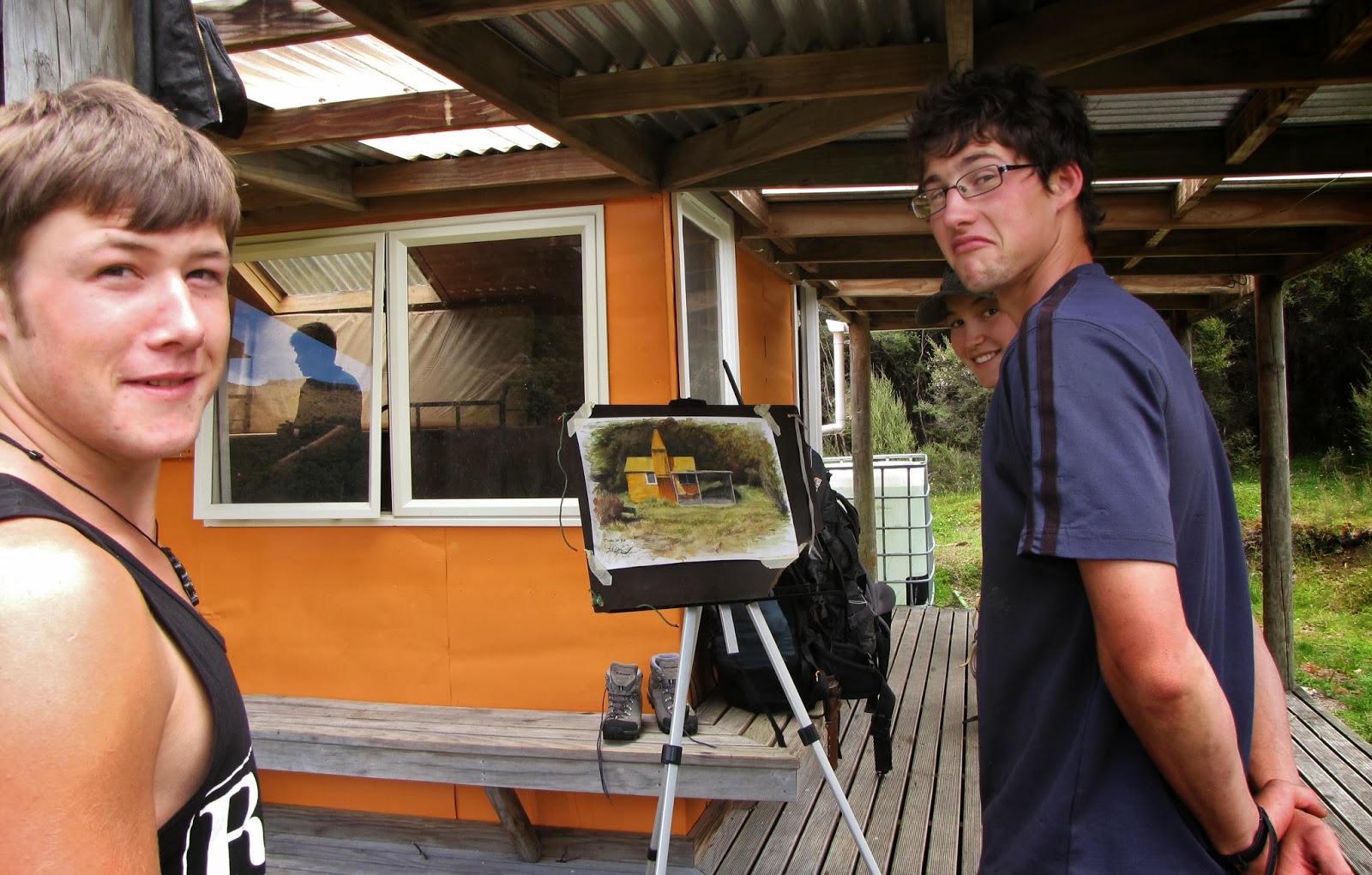
Jojo, Thomas, and Pauline, critiquing my work!
Middle Hill hut, Kawekas
Caleb's first deer, Te Ureweras
Trout and eel in the Kawekas, Rock's Ahead hut
Kiwi Mouth Hut, Kawekas
Old Manson Hut, Kawekas
Back Ridge Hut, Kawekas
At the end of a tramp
Whanganui Forest Park.
Blue Range Hut, Tararuas
Arete Forks Hut., Tararuas
Rainbow in the Tararuas
Dominic,. Marion, Pauline, Guillaume, me, and Jojo
Caleb and I in Ellis Hut, Ruahines
Me and Caleb at Sunrise Hut, Ruahines
Nikau Hut in the Orongorongo Valley, with Jerusalem
I am home again from another hut drawing trip in the bush. This was another 'hut hop' and part of my project 'The Art of a Hut' in which I am gathering material for a collection of drawings and paintings illustrating New Zealand's North Island backcountry huts.
The original plan was to be away for two weeks, but as things turned out we came home a little earlier, skipping the last two huts in the Pureora Forest Park. Here is a map of the original route planned which I drew up for my Mum's peace of mind.
The yellow line is the route we actually walked. So ending up on the wrong side of the national park was part of the reason for not moving on to the last two huts planned.
The most challenging part of this trip was that we hitch hiked all the way down and back out again. It made it all the more interesting and added several more hours of walking. The good thing about hitching was that it cost us nothing in travel except time, which we had. It also meant that we could come out of the bush at a different point and not have to end up back at the same car park.
Hitching on lonely country roads heading away from civilization is not something to be undertaken without being prepared to camp under a tree or two along the way. Estimated times of arrival vary a little... Two days hitching got us (Guillaume, Jerusalem, and I) to our arranged meeting point out the back of Eltham. Our last ride was with Mr and Mrs farmer Brown who were very kind and helpful to us. They didn't know of any DOC walking tracks at the end of the road, but we knew there was. They took us to their house while it was pouring with rain and let us use their computer to look at maps while they rang around the whole countryside to find out if there really was a track out there to Trains Hut. From the information gathered we learnt that there was/had been a track out there but no one had walked it for a long time and it was more than likely overgrown. It would be a challenge and a bit of a bush bash. But there was a track and so we carried on. Mrs Brown gave us a lift a fair way down the road and from there we walked...
Until it got dark and we made camp for the night under a hedge. Earlier, Jerusalem, who likes the idea of having only the very essentials for survival in the bush, had questioned Guillaume bringing a tarpaulin. But he soon was thankful for it! Next morning I woke up from what little sleep I had in a pool of water. That day was our longest day of walking. 13 hours of walking in hill country with a 20kg pack. Fun!...
We started at seven and walked for hours to the end of the road during which not one car passed us. We made good time and got to the end of the road at 11am. There was a house there and walking down the road we met a girl with pearls in her ears going to feed the ducks. We asked her for directions and she directed us up to the house to ask her parents. There we met one legged Billy. He was very friendly and willing to help. 'Hang on, I'll put a boot on and show you the way.'
He directed us to the beginning of the track which we would have struggled otherwise to have found. From there we walked on, found the beginning of the track, entered the bush, lost the track, found it again, and so on and so forth for the rest of the day. It was indeed a track of the lost variety. Most of the markers still remained which is all we had to go by. The rain that had been hanging about all morning began to dissipate and so that was something to be thankful for!
The walk took a lot longer than the 5h stated on the old sign at the beginning of the track. It actually took us 11 hours. Most of the time was lost in navigating through thick undergrowth, over fallen trees, and finding the next marker. We walked until 9pm when I was beginning to think I might accidentally fall asleep on my feet. After two hours of marker hunting by torchlight we decided to sleep and carry on in daylight. We nibbled on brussel sprouts (courtesy of one of the rides we hitched), cheese, and chocolate, pulled ourselves into sleeping bags and tried to sleep.
Next morning we walked down two hours and finally arrived at Trains Hut-- just after passing a sign that said 'this track is no longer maintained'! The joy of arriving! It was expressed very quietly as you can see in the videos I took. There were goats grazing around the hut when we arrived and Jerusalem didn't want us to scare them too far off as he wanted to go shoot one for meat.
It felt like we had arrived home. Water! Clean dry clothes, and food, in that order. Jerusalem being a qualified chef took on most of the cooking, and so we ate well. During the walk on day two he had shot a young goat and he curried it up for lunch.
So, first hut arrived at on day three. From then on it was much more simple. I would draw/paint the hut in the afternoon, in the morning we would walk to the next hut.
Above, inside Train's Hut, my painting in the windowstill. Below, Jerusalem on the roof smoking goat meat in the chimney.
We stayed one night each at Trains, Tahupo, and Puteore huts. The tracks were still not the smoothest but not as bad as coming into Trains. Those huts were very nice, cozy and well looked after. Though the stoves in Tahupo and Puteore were of the kind not helpful for cooking on.
At Tahupo Hut we made the decision to change our route and come out at Omaru Hut. This was mainly a result of our two biggest mistakes of the trip. Very silly ones and the result of some serious mismanagement which I must take responsibility for. First was not organizing soon enough how to cross the Whanganui River and then not being able to contact the Jet boat service once we had their number. That was no problem for the boys, of course we would swim across or make a raft, and we had a long rope... But we also didn't have a map of that area. Very bad idea, I don't know how we missed that one. We were supposed to buy one on the trip down, but with hitch hiking and a Saturday afternoon, we were not able to buy one... So, the track being uncertain, we decided not to add another mistake on top of others and planned to stay at extra huts on this side and come out another way.
Jerusalem napping after arriving at Puteore Hut.
Guillaume not liking the camera. We washed socks at most huts and there is always socks hanging around the chimney. Though on the first two hard days of walking Guillaume and I acquired some nasty blisters which caused us some grief. In this hut we had a feast. A recent DOC working team had just been in and left a whole lot of food with a note to help ourselves! Eggs, bread, butter, fizzy, and chutney, was very welcome.
I managed to make the weather look amazing in all my photos. But even drawing this hut I had to dash inside with my drawing and wait for a shower to pass. It rained every day that we were out there.
The view from Puteore Hut and the hut.
The walk from Puteore Hut to Pouri Hut hut was again on a 'no longer maintained track'. But we did not see that sign until the end of the walk! It wasn't a track, just a series of markers nailed to random trees though the bush. We had to cross a river on this walk, which meant going down, down down, to the river and then straight up again. After seven hours walking in the steadily worsening rain we suddenly came out onto the Matemateaonga Route, a great highway bulldozed through the jungle which we had just felt as if we were getting lost in. It was like stepping into civilization, and looking back one could hardly tell that there was a track at all where we had just come out of. We laughed with relief, to us it was the most amazing, wonderful, ridiculous thing we'd come across in a long time. Half an hour later, and after walking the same distance we had covered that morning in two hours we arrived at Pouri hut wet to the skin and freezing cold but happy.
We stayed a whole day and two nights at Pouri hut. Being a much more popular hut on a well frequented track, it was a much bigger hut, but not as nice as the smaller cozy basic huts. It rained-- it poured here, which my photos don't show! There were a couple of spells of sunshine during which I managed to do a few sketches of the hut, but most of the day was wet. There was an amazing view over the ranges which was hidden by a wall of white cloud most of the time. I managed to get a photo while the sun was shining.
On the 8th day of the trip we walked to the last hut, Omaru Hut. The last huts on a trip always seem to be the worst for drawing. I'm always exhausted, it's always raining and my drawing often doesn't turn out well. I tried painting between showers and hail. Didn't turn out great, then I sat on the floor of the hut and did an angry drawing of the stove. And that turned out alright. The strong hard lines seemed to compliment the subject. So something good did happen and my mood improved!
Guillaume and I decided we would press on and continue to Pureora Forest Park after getting out the next day. It would mean a long day hitching and possibly involve camping on the road somewhere. But the next day it became more and more obvious that we weren't up to that. We were hobbling along behind Jerusalem with sore feet and legs. It was only an hours walk out to the road, but after a few more hours walking down the very quiet road we decided that we'd head home. Our first ride was on the back of a farm ute which took us as far as 'the road' which was the Forgotten World Highway. There we split up with Jerusalem and after walking a fair way on the road towards Stratford we managed to get five rides to Hamilton where we stayed with Guillaume's sister and enjoyed hot showers and civilization again.
We didn't see anyone else while in the bush, I think most people are sensible and let the weather dictate when they will go tramping! Overall it was a good trip, and I got several good drawings and lots to continue working on at home. In another post soon I wrote about our hunting adventures which were very minimal thanks to 1080. Horrible stuff. But it is effective judging from the numbers of dead possums and rats we found on the tracks.
I'm glad to be home, but as soon as I'm rested I begin to think of more hut drawing trips. Still got the famous Tararuas to look forwards to. Also, this summer I hope to do a sailing trip and draw the few huts on the Northland coastline.